A Battery Stores Energy; It Does Not Create It
A battery stores energy; it does not create it. Follow a simple home backup scenario to see where its stored energy comes from and where it goes.
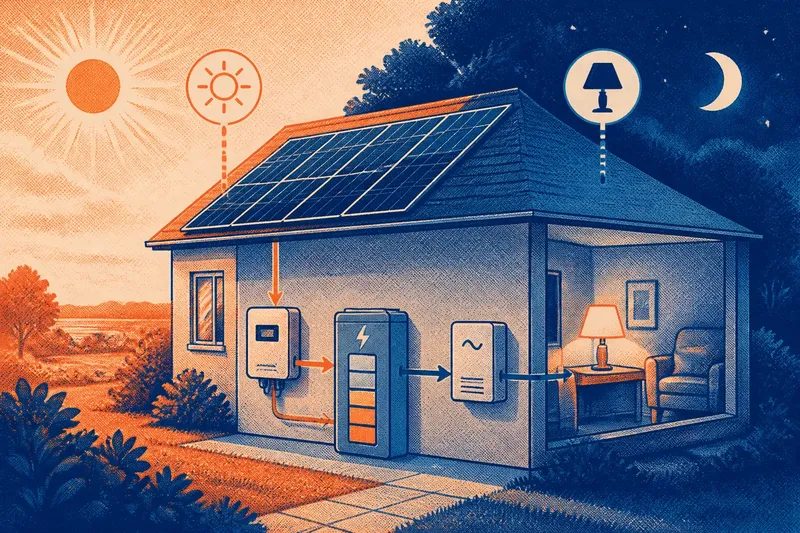
A battery stores energy; it does not create it. Imagine a home battery charged from rooftop solar during a bright afternoon, then used to run a lamp after sunset: the battery shifts energy from one time to another, but the original input still came from the solar panels.
That distinction can be easy to miss because a battery delivers electricity on demand. In the invented scenario below, the battery is useful precisely because it holds energy for later—not because it adds a new supply to the home.
The afternoon charge
Say a household has solar panels, a battery, and a lamp connected through an inverter. While the sun is shining, the panels convert sunlight into electrical energy. The home may use some of that electricity immediately; any available surplus can be directed to the battery, subject to the system’s controls and capacity.
The battery stores energy through chemical changes inside its cells. It is not a bucket of electricity: charging moves the cell into a state from which it can later deliver electrical energy. The inverter and other controls manage the exchange between the battery’s direct-current output and the alternating current used by many home circuits.
In this imagined household, the afternoon charging does not mean that the battery generated the energy. The solar panels supplied it, and the battery became a place to hold some of that supply. If the panels were not producing and the battery had no stored charge, the battery could not provide that same service.
The evening discharge
After sunset, the household turns on the lamp. The battery’s stored energy is released as electricity, passing through the system’s controls and inverter to the lamp. The light appears when it is needed, even though the panels are no longer receiving useful sunlight.
The result is a change in timing, not a new source. The battery lets the household use some energy that arrived earlier. It is a little like a pantry shelf: storing groceries makes them available later, but the shelf does not grow or produce the food.
In the invented situation, the observable result is straightforward: the lamp can draw on previously stored energy after the solar input has faded. If the household instead charged the battery from the electric grid, the energy would have come through the grid rather than directly from the panels. The battery would still be storing and releasing energy, not generating it.
Why stored energy changes
A battery does not return every unit of energy put into it. Some energy is lost during charging, while stored, and during discharge, often appearing as heat or being used by the system’s electronics. The precise behavior depends on the battery chemistry, equipment, settings, and operating conditions.
So the evening lamp may receive less energy than the panels supplied to the battery during the afternoon. That does not make the battery a generator; it means storage involves conversion and losses. A phone battery works on the same broad principle: a charger supplies energy, the battery holds part of it in chemical form, and the phone later draws on that reserve.
The household’s battery also has limits. It can store only as much as its design and controls allow, and it cannot keep supplying power indefinitely without another input. A battery’s stored energy is a reserve, not an endless supply.
What the scenario teaches
Follow the energy in the imagined home, and the roles stay clear:
- Source: Sunlight provides the initial input in this scenario.
- Conversion: Solar panels turn that input into electrical energy.
- Storage: The battery holds some available energy for later use.
- Release: The battery supplies electricity to the lamp after sunset.
- Loss: Some energy is dissipated along the way rather than reaching the lamp.
Change the charging source and the storage role remains the same. A battery charged by grid electricity, a generator, or another supply still stores energy it received. The source answers where the energy came from; the battery answers when some of it can be used.
Questions about batteries?
Is a battery an energy source?
In everyday conversation, people may call a battery a power source because it can supply electricity to a device. More precisely, it is an energy-storage device: it releases energy that was previously put into it.
Where does battery energy come from?
It comes from whatever supplied energy during charging, such as a solar system, the electric grid, or a charger connected to another source. The battery stores some of that input in chemical form.
Can a battery generate electricity?
A discharging battery produces an electrical output through chemical reactions, so it can provide electricity to a circuit. That output is a conversion and release of stored energy, not creation of energy from nothing.
Why use storage if it loses energy?
Storage can make energy available at a more useful time, such as after solar production has declined. Whether that timing benefit suits a particular system depends on its needs, equipment, and energy inputs.
Reading the energy path
When someone says a home “runs on batteries,” ask what charged them. That small question separates the immediate supply from the original source and makes the energy path easier to picture. For the imagined household, the answer is sunlight in the afternoon, stored chemical energy inside the battery, and electricity delivered to the lamp later.
A battery stores energy; it does not create it. Keeping that phrase in mind helps make sense of backup systems, phones, and other devices: storage changes when energy is available, while a source supplies the energy in the first place.