From Spinning Turbines to a Flow of Electricity
Learn how a spinning turbine drives a generator, changing mechanical energy into electrical energy through magnetic fields, coils, and a complete circuit.
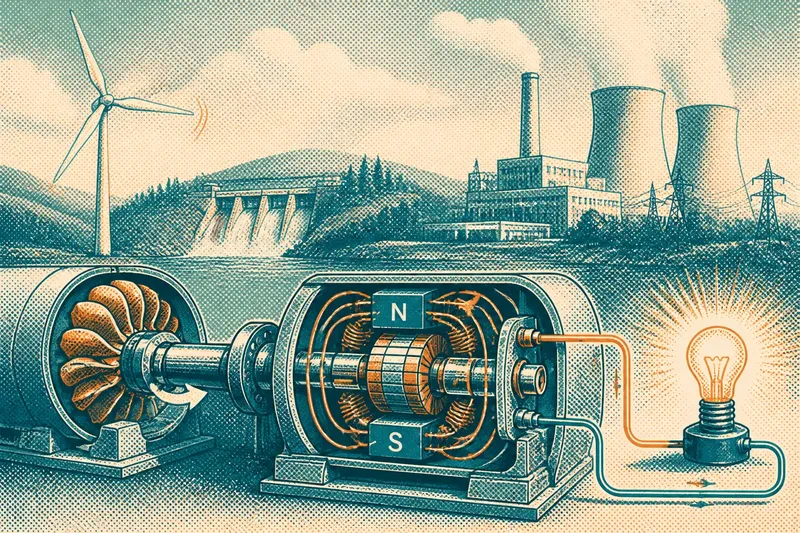
A spinning turbine does not send electricity straight into a wire; it turns a generator, where motion and magnetism produce a changing electrical push. Understanding how a turbine generates electricity means following an energy conversion from the moving machinery to the current that can travel through a connected circuit.
The sequence below focuses on the generator itself: what turns, how magnetic fields matter, and why a circuit is needed for a continuing flow. Think of the parts as a hand-cranked flashlight’s dynamo enlarged and driven by a turbine. The principle is similar, even though a power-station generator is built for a very different scale and purpose.
1. Trace the incoming energy
A generator needs a source of motion. A turbine provides that motion by rotating a shaft, but the turbine’s own energy source varies. Moving water can push turbine blades in a hydroelectric station; steam can drive blades in a thermal power station; and wind can turn the rotor of a wind turbine.
Those sources do not all deliver energy in the same way, yet each can set rotating machinery in motion. In a wind turbine, for instance, the blades turn a rotor connected to a generator. In a steam-powered plant, steam expands through the turbine and turns its shaft. In both cases, motion is the immediate input to the generator.
This distinction helps keep the process clear: the turbine captures or transfers energy from a source, while the generator converts the resulting mechanical energy into electrical energy. The generator does not create energy from nothing. Some energy is also dispersed into the surroundings, including as heat and sound, rather than becoming useful electrical output.
2. Follow the rotating shaft
The turbine’s rotating shaft carries mechanical energy to the generator. Depending on the machine’s design, the shaft may connect directly to the generator or connect through other equipment. The important point is that something inside the generator must rotate relative to another part.
That relative movement is the working ingredient. A shaft turning with nothing arranged to produce a changing magnetic field would not, by rotation alone, explain how current appears in a circuit. The generator is built so that rotation changes the magnetic conditions around conducting wire.
Imagine a small workshop where a turning hand crank drives a simple generator connected to a lamp. The crank supplies mechanical energy; the generator converts part of that input into electrical energy; and the connected lamp can then use the electrical supply to produce light. If the crank stops, the generator’s motion stops too, so it no longer continues the same conversion.
3. Create relative motion
Inside a generator are magnetic fields and coils of conductive wire. A coil is wire arranged in loops, often around a core that helps shape the magnetic field. The generator’s design makes the magnetic field through the coil change as the machine turns.
In one common arrangement, magnets rotate near stationary coils. In another, a rotating part carries the magnetic field while coils remain in place. The moving and stationary parts can be arranged differently, but the central idea is the same: rotation changes the relationship between the magnetic field and the wire.
A plain analogy is a card being moved through a hole in a key ring: what matters is the card’s motion relative to the ring, not which object someone chooses to hold still. A generator uses carefully arranged magnetic fields and coils rather than a card and ring, but relative motion helps explain why the machine’s internal arrangement can vary.
4. Induce a voltage
As the magnetic field through a conducting coil changes, it induces a voltage across the wire. Voltage is the electrical push that can drive charges around a circuit. This process is called electromagnetic induction, and it is the core link between a generator’s mechanical motion and its electrical output.
The word “induces” matters: the generator does not need a spinning part to rub directly against the wire and push charges around like a mechanical contact. Instead, changing magnetic conditions produce the voltage. The coils provide a path in which charges can respond when the circuit is connected.
More turns of wire or a stronger changing magnetic field can affect the induced voltage, while the speed of relative motion also matters. Those are design relationships, not a promise that every generator behaves identically. A machine’s output depends on its construction and operating conditions.
5. Complete the circuit
Voltage can exist across the generator’s terminals, but a continuing current needs a complete electrical circuit. When the generator is connected to a suitable load through conductors, charges can move around the closed path. The load might be a lamp, a motor, or other equipment designed to use electrical energy.
If the circuit is open, the path is broken, so a sustained current cannot flow through the load. The generator may still be rotating and producing voltage at its terminals, but the connected device will not receive a continuing current through a broken path. Closing the circuit allows electrical energy to be transferred to the load.
This is why a generator is more than a magnet and a coil in isolation. Its terminals, connections, and external circuit complete the route for energy transfer. The electrical current is not a substance poured from the generator; it is the movement of charges in a circuit, driven by voltage.
6. Recognize alternating current
Many generators produce alternating current, or AC. As the machine rotates, the induced voltage changes direction in a repeating pattern, and the current in the connected circuit reverses direction as well. The rate of this reversal depends on the generator’s design and rotation.
Not every generator produces the same kind of output. Some designs produce direct current, or output that is later converted into a different form. Power systems may also use equipment to adjust electrical output for its intended destination. Those additional stages do not alter the basic conversion inside the generator: motion changes a magnetic field around conductors, inducing voltage.
It is useful to separate the generator’s immediate output from what happens afterward. A power station may include transformers, controls, and other electrical equipment, but those devices serve purposes beyond the initial conversion of mechanical energy into electrical energy.
7. Connect the energy changes
The full chain can be stated plainly: an energy source sets a turbine in motion; the turbine turns a shaft; the shaft drives relative motion inside a generator; changing magnetic fields induce voltage in coils; and a complete circuit allows electrical energy to reach a load.
Each link has a different job. The turbine converts energy from its source into rotation, the shaft carries that mechanical energy, and the generator converts some of it into electrical energy. A connected load then transforms electrical energy into another useful form, such as light, sound, or motion.
Thinking in conversions also explains why “electricity comes from the turbine” is only a shorthand. The turbine supplies the motion, but the generator is where that motion is converted into an electrical output. The source, turbine, generator, circuit, and load are connected parts of one energy pathway.
Generator questions?
Does a turbine make electricity by itself?
No. A turbine turns a shaft, and the generator uses that mechanical motion to induce voltage. The turbine and generator work together, but they perform different parts of the conversion.
Why do generators use coils and magnets?
Conductive coils provide a place for charges to move, while changing magnetic fields induce voltage in the wire. Relative motion between the field and coil creates the changing conditions the generator needs.
Can a generator produce electricity without a load?
A generator can produce voltage at its terminals while rotating, even if no load is connected. Without a complete circuit, however, there is no continuing current through an external load.
What makes a generator stop producing output?
If the motion that drives it stops, the changing magnetic conditions stop as well, so the generator no longer produces the same induced voltage. A fault or disconnected circuit can also prevent electrical energy from reaching a particular load.
Keep the conversion clear
When you hear that a wind turbine or water turbine generates electricity, look for the generator in the middle of the story. The turbine supplies rotation; magnetic fields and coils turn that mechanical input into voltage; and a complete circuit lets electrical energy move to something that can use it.
That simple sequence is a useful way to understand how a turbine generates electricity without confusing the energy source with the conversion device. Follow the motion to the shaft, the shaft to the changing magnetic field, and the generator terminals to a complete circuit: each connection explains a different part of the flow.