Before the Grid: A Short History of Local Electricity Supply
Local electricity supply linked nearby generators to their customers. Learn how early systems worked and why interconnection changed the reach of power.
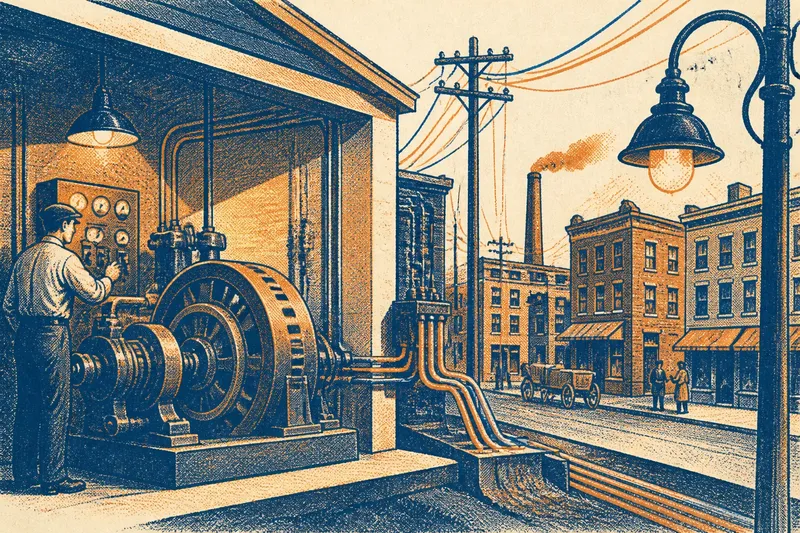
Local electricity supply usually served customers near the generator, not an entire region. In the late nineteenth century, early lighting stations in cities such as New York supplied nearby buildings through local wires; separate systems had no automatic way to exchange power.
Nearby customers
Early electric lighting systems were often built around a particular site or district. A factory could run its own generator, while a lighting company might serve nearby businesses and streets from a local station.
The boundary of each supply system was practical: it followed the wires and equipment that had been installed. A generator serving a hotel could not send electricity to another town unless a connection and suitable distribution equipment linked the two places.
Ownership and purpose varied. Some systems supplied a business’s own premises; others sold electricity to a cluster of customers. In either case, the generator and its users were close enough to belong to one local arrangement.
Local supply limits
Operators had to match the electricity available from a station with the needs of its customers. Adding users could require changes at the generator, along the wires, or both. A nearby connection was possible only if the equipment could serve the added demand.
Say a mill has a generator for its own workshop, and a neighboring shop asks to connect. The mill owner would first consider whether the generator and local wiring could serve the shop, then whether extending the wires was practical. If both decisions favor a connection, the shop becomes another local customer; the supply still does not reach beyond the system’s wires.
Interconnected systems
Interconnection joins separate electricity systems so power can move between them. It changes more than the length of the wires: operators can consider supply and demand across linked locations rather than treating every station as an island.
A useful everyday analogy is a shared hallway between rooms: it gives people a route between spaces, but it does not make every room identical. Likewise, linked systems can exchange electricity while retaining local generators, equipment, owners, and operating responsibilities.
With suitable connections, a district can receive electricity from beyond its own boundary, and local generation can contribute to a wider network. The route and equipment determine what can be shared, while operators coordinate how connected parts work together.
What changed
Interconnection shifted electricity supply from separate local arrangements toward cooperation across a broader area. When one connected location had available generation and another needed supply, a network link could provide a path between them.
A wider network can reduce reliance on a single local station, but connection is an option, not an unlimited source. If the relevant lines or equipment cannot carry the needed power, the link cannot resolve the local constraint by itself.
Customers also became less able to infer a generator’s location from the electricity reaching a lamp. Supply could involve multiple stations and districts, even though the customer still relied on local wires to receive it.
Network boundaries
An interconnected network is not a boundless pool. Its ability to move electricity depends on available generation, the paths joining places, and the equipment’s operating limits.
Connection also requires coordination among the people responsible for different parts of the system. Local stations do not disappear when a larger network forms; they become components of a broader arrangement, with their role shaped by both local needs and network conditions.
Local supply questions?
Why did early systems serve nearby users?
Generators and distribution wires were installed for particular buildings or nearby customers, rather than as links between distant districts. A system could reach only where its equipment and connections allowed.
What does interconnection mean?
Interconnection links previously separate electricity systems so they can exchange power through connected equipment. It allows supply and demand to be considered across a wider area than a single local station.
Did a grid make local generators unnecessary?
No. A local generator could continue to supply nearby users or contribute to the connected network. Interconnection added possible sources and routes of supply; it did not remove the need to generate electricity.
Does a wider network remove supply limits?
No. Available generation, network paths, and equipment limits still shape what can be shared. A connection helps only when the connected system can carry and coordinate the power.
Reading local supply
The history of local electricity supply is a shift in the scale of cooperation: nearby generators and customers became parts of networks that could share power across connected places. Local equipment remained essential, but it no longer defined the only possible source of supply.
When you look at an electricity system, ask which places are connected and what routes link them. That distinction helps explain why a nearby generator may matter to a community even when its electricity can also come from elsewhere.