Overhead Lines and Underground Cables: Two Routes for Power
Overhead lines and underground cables solve different network problems; understand their layouts, visible trade-offs, and why planners use both.
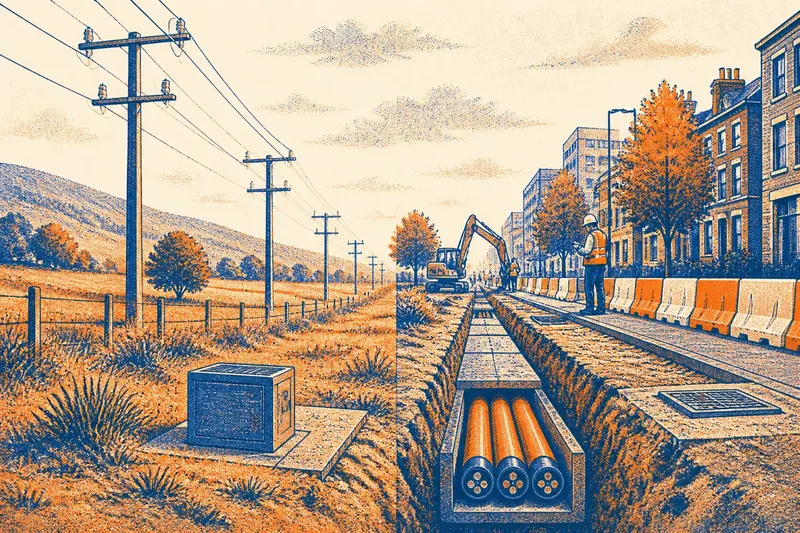
Overhead lines and underground cables carry electricity through very different landscapes, and each route makes some network problems easier while creating others. Overhead lines are visible on poles or towers; underground cables disappear beneath streets, fields, and building sites. Neither is simply the more modern version of the other. Their use reflects the terrain, the surrounding land, the amount of power to move, and the practical demands of building and maintaining a network.
Thinking about the route as part of the network helps explain the choice. A line is not just a wire from one point to another: it needs supports, clearances, connections, access for crews, and a way to fit around roads, property, and other utilities. The trade-offs are a little like choosing between a footbridge and a tunnel: the route changes what is visible and how access works, but both still have to connect the places people need.
How routes differ
Overhead power routes use conductors suspended from poles or lattice towers. Insulators keep the energized conductors separated from their supports, while the structures maintain clearances from the ground, trees, buildings, and one another. The supports and wires form a visible corridor that can cross open land or follow roads and other established routes.
Underground routes place insulated cables below the surface. Depending on the network and location, cables may sit in ducts, trenches, or other protective arrangements. The route also needs joints and connection points, and crews need access to those locations when inspection or repair is required. A cable can be out of sight without being absent from the landscape: cabinets, access covers, or marked corridors may indicate where network equipment lies.
Both arrangements must connect to substations and other network equipment. A change from overhead to underground construction therefore involves more than replacing a visible wire with a buried one. The transition needs suitable equipment and space, and it must fit the electrical design of the surrounding network.
Why overhead lines remain
Overhead construction can be comparatively straightforward to extend across open ground where a clear route is available. Crews can see the conductors and supporting structures, which makes visual inspection possible without excavating the corridor. If a component needs attention, workers can often reach it from the surface using appropriate equipment and access arrangements.
That visibility comes with exposure. Wind, ice, falling branches, and other physical contact can damage lines or supports, while vegetation management is an ongoing part of keeping clearances. The route can also affect the appearance of a neighborhood or landscape, and the structures require space along their path.
Overhead lines are not necessarily the only practical option in open country, nor are they always easy to build. Uneven terrain, difficult access, protected areas, and the need to cross roads or waterways can complicate construction. A route that looks simple on a map may demand careful siting and coordination on the ground.
Why cables go underground
Buried cables are often considered where visible structures would conflict with the surrounding setting or where an established street corridor offers a workable route. They can keep conductors out of sight and reduce direct exposure to windblown branches or contact with objects above ground. In built-up areas, placing equipment below the surface may also help fit a network into streets already crowded with buildings and other infrastructure.
Burial shifts the challenge rather than removing it. Excavation can disrupt pavement, landscaping, traffic, and nearby services. The route must be coordinated with water pipes, drainage, communications lines, foundations, and other buried assets, and access for later repairs can involve opening the surface again.
Heat also matters to cable design. Soil conditions, installation arrangements, and the amount of heat a cable must carry influence how a buried route is planned. Cables can require different electrical and protective equipment from overhead lines, so planners consider how the route will operate as part of the wider network rather than treating burial as a simple covering choice.
Where problems begin
Some route problems are visible, while others show up only when construction or maintenance starts. Common sources include physical damage, limited access, conflicts with other land uses, and assumptions about what lies beneath a proposed path. The cause often points to a different kind of response.
- Branches approach an overhead line: Vegetation can encroach on required clearances or fall onto equipment. Network operators manage vegetation along the route; residents should report a concern rather than approach a line or attempt pruning near it.
- A buried route is hard to locate: Old plans may be incomplete, or several utilities may share a crowded corridor. Before digging or planning construction, use the local utility-location process and confirm the route through the appropriate service.
- Road work repeatedly affects the same corridor: Several buried services may compete for limited space, so one project can obstruct access to another. Coordinating utility work and keeping accurate route records can reduce avoidable clashes.
- People expect a buried line to be immune to outages: Underground construction avoids some exposures but can still be affected by water intrusion, excavation damage, equipment faults, or other network problems. The useful question is which risks the route reduces and which remain.
For any specific site, the route depends on the network design, the cable or line equipment, land conditions, and local requirements. Where a decision touches utility work, property boundaries, or construction safety, consult the network operator or a qualified professional rather than inferring a route from appearances.
Why does the route matter?
Are underground cables always more reliable?
No route is free from faults. Burial avoids some weather-related exposure, but faults can be difficult to locate and repairs may require excavation, while overhead equipment can be exposed yet easier to inspect visually.
Why not bury every power line?
Burial can require substantial excavation, careful coordination with existing utilities, and specialized cable equipment. In some corridors, overhead structures may offer a more workable way to carry power and reach equipment for maintenance.
Why do some networks mix both types?
A network may use overhead construction where open routes suit it and underground cable where streets, buildings, or local constraints favor burial. Transition points connect the two arrangements, so the choice can vary along a single route.
Can a buried cable be identified from the surface?
Sometimes a marker, cabinet, or access cover indicates nearby equipment, but surface clues do not establish the exact cable path. Utility-location services and network records are the safer basis for planning work near buried services.
A route in practice
Say a fictional town is planning a connection from a substation to a new neighborhood beside a busy road. An overhead route might avoid a long excavation project but require supports and a clear corridor; a buried route might keep the conductors out of view but compete for space with pipes and communications ducts. Planners could compare those constraints, identify connection points, and consult the relevant network operator before settling on a route. The observable result would be a proposed alignment that accounts for both the neighborhood and the work needed to build and maintain the connection.
When comparing overhead lines and underground cables, separate what is easy to see from what the route requires behind the scenes. A clear corridor can favor accessible overhead equipment; a crowded or sensitive surface may make burial worth considering, provided there is room and access below ground. The most useful question is not which route looks better in isolation, but which set of trade-offs fits the job the network must do.